ALLPOWERS 1024Wh 1800W Power Station vs ALLPOWERS Portable Power Station P1800: Spec Comparison
As an Amazon Associate we earn from qualifying purchases. Links on this page are affiliate links.
You are comparing the allpowers 1024wh 1800w power station vs portable power station p1800. Both units offer 1024Wh of LiFePO4 capacity and 1800W of continuous output. The main difference lies in their physical dimensions and included accessories. Product A lists specific weight and dimensions, while Product B omits weight. Both support solar charging and include a UPS function. This guide breaks down the spec differences to help you choose.
Key differences
| Aspect | ALLPOWERS 1024Wh 1800W Power Station | ALLPOWERS P1800 1024Wh Outdoor Power |
|---|---|---|
| Dimensions | 14.7 x 8.2 x 11.7 inches | 12.3 x 10.4 x 16.3 inches |
| Weight | 28.7 pounds | not listed |
| Solar Input | 650W Max (11-60V) | 650W Max |
| Charging Time | not listed | 80% in 40 minutes |
| Warranty | 5-Year | not listed |
Which one should you choose?
Choose ALLPOWERS 1024Wh 1800W Power Station if
- You need to know the exact weight for transport planning
- You want a longer warranty period for peace of mind
- You prefer a flatter, wider form factor for storage
Choose ALLPOWERS P1800 1024Wh Outdoor Power if
- You prioritize ultra-fast AC charging capabilities
- You prefer a taller, more compact footprint
- You want explicit confirmation of the 80% charge time
Verdict: Choose Product A if you need precise weight data and a longer warranty. Choose Product B if fast charging speed and a different physical shape are your priorities. Both units provide identical core power output and battery chemistry for your needs.
Size, Weight, and Charging Specs
Physical dimensions
Product A measures 14.7 by 8.2 by 11.7 inches, while Product B is 12.3 by 10.4 by 16.3 inches. The first unit is wider but shorter in height, making it potentially easier to fit in standard car trunks or under seats. Product B is taller and narrower, which might stack better in tight vertical spaces. You should measure your storage area before deciding. The footprint of Product A is larger, but its lower profile could be an advantage for stability on uneven surfaces. Product B’s compact width offers a different carrying experience. Neither size is inherently better; it depends on your specific gear layout.
Weight
Product A explicitly lists a weight of 28.7 pounds. Product B does not provide a weight specification in its data. Since both units share the same 1024Wh LiFePO4 battery capacity and similar output ratings, their weights are likely comparable, but you cannot confirm this without Product B’s data. If Product B is significantly heavier, Product A would be easier to carry for camping or travel. If it is lighter, Product B wins on portability. Until you verify the actual weight of Product B, you should assume they are similar. Always check the manual for Product B before making a final decision on transport.
Charging speed
Product B highlights an UltraFast Charging Mode that reaches 80% charge in just 40 minutes via a wall outlet. Product A mentions triple charging methods including AC wall charging but does not specify a time to full or 80% charge. This specific speed metric gives Product B a clear advantage for users who need to quickly replenish power during short breaks. If you rely on wall outlets for rapid top-ups, Product B’s documented 40-minute cycle is a significant practical benefit. Product A’s charging speed remains unspecified, so you cannot compare it directly. For fast turnaround times, Product B provides the verified data you need.
Solar input
Both products support solar charging with a maximum input of 650W. Product A specifies an MPPT voltage range of 11-60V and a current of 13A. Product B lists the 650W max but does not detail the voltage or current parameters. The shared 650W limit means both can accept similar solar panel arrays. However, Product A’s specific voltage range helps you choose compatible panels more easily. You need to ensure your solar panels operate within the 11-60V window for optimal efficiency. Product B’s lack of specific voltage data might require you to check the manual. For technical compatibility, Product A offers more immediate guidance.
Warranty
Product A includes a 5-year warranty, which is explicitly stated in its features. Product B does not mention a warranty period in its provided data. A five-year coverage period offers longer protection against defects and battery degradation. This is a significant advantage for long-term reliability and peace of mind. You should verify if Product B offers any warranty, as it is not listed here. If Product B has a shorter or no stated warranty, Product A is the safer choice for investment protection. For now, the documented five-year term gives Product A a clear edge in customer support duration.
Which ALLPOWERS P1800 model suits you
You need precise weight and size data
Product A provides explicit weight and dimension specs. It weighs 28.7 pounds and measures 14.7 by 8.2 by 11.7 inches. Product B lists dimensions but omits weight. If you need to verify transport limits or storage space constraints, Product A offers the necessary numerical details for accurate planning.
You want app control and warranty coverage
Product A includes smart app control for monitoring and scheduling. It also comes with a 5-year warranty. Product B does not mention app connectivity or warranty terms in its data. If remote management and long-term protection are priorities for your home backup or camping setup, Product A provides these specific benefits.
You prefer faster wall charging speeds
Product B highlights an ultra-fast charging mode that reaches 80% capacity in just 40 minutes via a wall outlet. Product A lists triple charging methods but does not specify this rapid recharge time. If you need to replenish power quickly during short breaks or emergencies, Product B offers this specific performance advantage.
The products compared

ALLPOWERS 1024Wh 1800W Power Station
Best for: high-wattage home backup and RV power
- Running Wattage
- 1800W
- Surge Wattage
- 3600W
- Capacity
- 1024Wh
- Battery Chemistry
- LiFePO4
- Output Ports
- 4 AC, 2 USB-C, 2 USB-A, 1 car outlet
- Application
- Camping, Home, Emergency, RV
View on Amazon: ALLPOWERS 1024Wh 1800W Power Station Affiliate link
The ALLPOWers P1800 delivers 1800W of continuous power with a 3600W surge capacity. Its 1024Wh LiFePO4 battery offers 4000+ cycles and a 20ms UPS function. You get four AC outlets, dual 140W USB-C ports, and triple charging via solar, wall, or car. The unit weighs 28.7 lbs and measures 14.7x8.2x11.7 inches. It includes app control and a 5-year warranty for reliable home or outdoor use.
Pros
- 1800W running wattage with 3600W surge
- 1024Wh LiFePO4 battery with 4000+ cycles
- 20ms UPS backup for uninterrupted power
- Dual 140W USB-C and four AC outlets
- Smart app control for monitoring and scheduling
Cons
- 28.7 lb weight limits easy carrying
- 650W max solar input restricts solar speed
- No built-in handles mentioned in specs
Good fit if
- You need 1800W continuous power for tools
- You want LiFePO4 battery longevity
- You prefer app-based monitoring
Skip if
- You need more than 1800W running power
- You require fast solar charging above 650W
- You need a lighter unit under 20 lbs
Verdict: The ALLPOWers P1800 1024Wh 1800W Power Station fits users needing high wattage and long battery life for home backup or RV trips. Its app control and UPS function add practical value for critical loads.
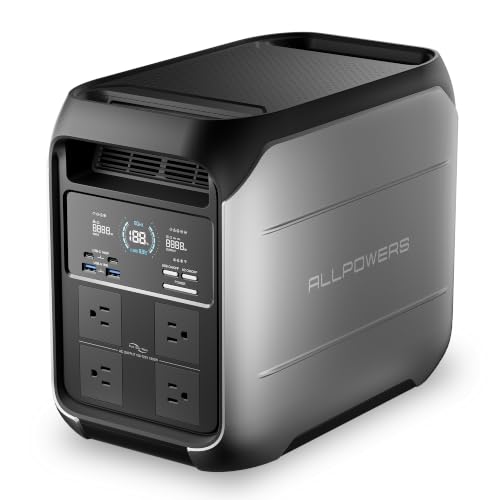
ALLPOWERS P1800 1024Wh Outdoor Power
Best for: Home backup and fast AC charging needs
- Running Wattage
- 1800 W
- Surge Wattage
- 3600 W
- Capacity
- 1024 Wh
- Battery Chemistry
- LiFePO4
- Output Ports
- 4x AC, 2x USB-C, 2x USB-A, 1x 12V
- Voltage
- 120V
View on Amazon: ALLPOWERS P1800 1024Wh Outdoor Power Affiliate link
The ALLPOWers P1800 offers 1024Wh of LiFePO4 battery capacity and 1800W continuous AC output. It features ultra-fast charging, reaching 80% in 40 minutes via wall outlet, and supports 650W solar input. The unit includes a 20ms UPS function for sensitive electronics. With four AC outlets and multiple USB ports, it powers nine devices simultaneously. This station suits users needing reliable backup power for home or outdoor use.
Pros
- 1024Wh LiFePO4 battery lasts over 4,000 cycles
- Reaches 80% charge in 40 minutes via AC
- 20ms UPS protects sensitive devices during outages
- Supports up to 650W solar panel input
- Four AC outlets and multiple USB ports
Cons
- No remote control included for operation
- No mobile app for monitoring or control
- Solar panels must be purchased separately
Good fit if
- You need a reliable UPS for home office equipment
- You want fast AC recharging for quick turnarounds
- You require high solar input for off-grid camping
Skip if
- You need a built-in remote for convenience
- You want app-based monitoring and control
- You expect solar panels to be included
Verdict: The ALLPOWers P1800 1024Wh Power Station is a robust backup solution for users who prioritize fast AC charging and UPS reliability for sensitive home electronics. It fits those who can source their own solar panels.
Specifications side by side
| Spec | ALLPOWERS 1024Wh 1800W Power Station | ALLPOWERS P1800 1024Wh Outdoor Power |
|---|---|---|
| Running Wattage | 1800W | 1800 W |
| Surge Wattage | 3600W | 3600 W |
| Capacity | 1024Wh | 1024 Wh |
| Battery Chemistry | LiFePO4 | LiFePO4 |
| Output Ports | 4 AC, 2 USB-C, 2 USB-A, 1 car outlet | 4x AC, 2x USB-C, 2x USB-A, 1x 12V |
| Voltage | not stated | 120V |
| Solar Panel Wattage | not stated | 650 W (max input) |
| Wattage | 1800W | 1800W |
| Application | Camping, Home, Emergency, RV | Camping, Outdoor, Travel, Power Outage |
| Features | not stated | Solar Charging |
| Dimensions | 14.7 × 8.2 × 11.7 inches | 12.3 × 10.4 × 16.3 inches |
| Weight | 28.7 pounds | not stated |
| Size | P1800 | not stated |
| Color | 1800W | P1800 |
| Model | P1800 | P1800 |
Frequently asked questions
Do both ALLPOWERS P1800 models have the same battery capacity?
Yes, both units offer 1024Wh of storage. This capacity supports high-wattage appliances and extended outages. The first model is rated for home backup and RV use. The second model emphasizes fast AC charging and UPS reliability for sensitive electronics.
Which power station is lighter for transport?
The first model lists a weight of 28.7 pounds. The second model does not provide a weight specification in its data. You should assume the first unit is manageable for most users. Check the second unit's dimensions if weight is critical for your carry method.
Can I use these units as a UPS for my home?
Yes, both are suitable for UPS functions. The first model explicitly includes app control and UPS features. The second model also highlights UPS reliability for critical home electronics. Both provide 1800W of continuous output to keep devices running during power cuts.
Do these models support solar charging?
Yes, both support solar input. The second model lists solar charging as a key feature. The first model is designed for home backup and RV trips where solar compatibility is essential. You can source your own panels to recharge the 1024Wh battery.
What is the difference in physical size between the two?
The first unit measures 14.7 by 8.2 by 11.7 inches. The second unit is 12.3 by 10.4 by 16.3 inches. The first is wider but shorter in height. The second is taller and narrower. Choose based on your storage space constraints.
Are both models built with LiFePO4 battery chemistry?
Yes, both utilize LiFePO4 battery chemistry. This provides longer cycle life and safety. The first model targets high-wattage home backup. The second is ideal for outdoor and travel applications. Both offer 1800W continuous output for versatile power needs.
Which model is better for RV power?
The first model is best for RV power. It is explicitly recommended for RV trips and home backup. Both offer 1024Wh capacity. The first unit’s dimensions may fit standard RV storage spaces better. Its app control adds convenience for monitoring power usage on the road.