ALLPOWERS R2500 V2 160W Solar vs ALLPOWERS Solar Generator P1800 200W (2026): Key Differences
As an Amazon Associate we earn from qualifying purchases. Links on this page are affiliate links.
This allpowers r2500 v2 160w solar vs solar generator p1800 200w comparison looks at two LiFePO4 units from the same brand. Both offer solar charging and pure sine wave output for home or outdoor use. The main difference lies in their power capacity and output strength. The R2500 V2 provides significantly higher wattage and storage, while the P1800 focuses on faster charging speeds and a more compact form factor. You need to weigh raw power against portability.
Key differences
| Aspect | ALLPOWERS R2500 V2 with 160W Solar Panel | ALLPOWERS P1800 1024Wh LiFePO4 |
|---|---|---|
| Capacity | 1920Wh | 1024Wh |
| Running Wattage | 2500W | 1600W |
| Surge Wattage | 5000W | 3200W |
| Battery Cycles | 3500+ to 80% | 4000+ to 80% |
| Solar Panel Included | 160W Monocrystalline | 200W Foldable |
| Weight | 54 pounds | not listed |
Which one should you choose?
Choose ALLPOWERS R2500 V2 with 160W Solar Panel if
- You need to run heavy appliances like air conditioners or power tools requiring high surge power.
- You want a larger energy buffer for extended off-grid use or longer power outages.
- You prefer a unit with a higher total number of output ports for multiple devices.
Choose ALLPOWERS P1800 1024Wh LiFePO4 if
- You prioritize faster AC charging times, reaching 80% in just 40 minutes.
- You want a foldable solar panel that is easier to transport and set up.
- You need a more compact unit for camping or travel where space is limited.
Verdict: The R2500 V2 is the better choice if you need raw power and capacity for home backup or heavy-duty tasks. The P1800 suits users who value portability, faster charging, and a foldable panel for outdoor adventures. Both units share durable LiFePO4 chemistry, ensuring long-term reliability for either use case.
Comparing Power Output and Capacity
Capacity
The ALLPOWERS R2500 V2 offers a massive 1920Wh capacity, nearly doubling the 1024Wh stored in the P1800. This larger reservoir means you can run high-drain appliances for significantly longer periods. If you plan to power a refrigerator or run multiple devices overnight, the R2500 V2 provides more runtime. The P1800’s smaller capacity makes it better suited for shorter trips or charging phones and laptops. You must decide if the extra energy justifies the larger footprint and weight of the R2500 V2 for your specific needs.
Wattage
Power output differs sharply between these two units. The R2500 V2 delivers 2500W of continuous running power and 5000W surge, handling heavy tools or air conditioners. The P1800 provides 1600W continuous and 3200W surge, which is sufficient for most camping gear but struggles with larger appliances. If you need to run a microwave or power drill, the R2500 V2 is the clear choice. The P1800 is adequate for standard electronics but lacks the raw power for demanding loads. Check your device requirements before choosing.
Battery Chemistry
Both units utilize LiFePO4 battery chemistry, which is a significant advantage for longevity. This chemistry supports thousands of charge cycles with minimal degradation. The P1800 is rated for over 4,000 cycles to 80% capacity, while the R2500 V2 offers 3,500+ cycles. Both provide over a decade of daily use. Since both use the same durable cell type, neither has a technical edge here. You get long-term reliability and safety from either model, making this a neutral comparison for battery health.
Solar Input
Solar charging capabilities vary. The P1800 supports up to 650W of solar input, allowing for much faster replenishment from panels. The R2500 V2 data does not list its maximum solar input, so you cannot verify its solar charging speed. However, the included solar panel differs; the P1800 comes with a 200W foldable panel, while the R2500 V2 includes a 160W rigid panel. The P1800’s higher input limit offers more flexibility for future panel upgrades.
Output Ports
Connectivity options differ in variety. The R2500 V2 features 13 output ports, providing numerous ways to connect devices. The P1800 lists four AC outlets, two 100W USB-C ports, two 18W USB-A ports, and one car socket. While the P1800 includes high-speed USB-C charging, the R2500 V2 offers more total ports for simultaneous use. If you need to plug in many devices at once, the R2500 V2 provides greater flexibility with its extensive port selection.
Choose the right power station for you
You need to run heavy appliances like ACs
The R2500 V2 delivers 2500W of continuous power and a 5000W surge. This capacity allows you to run high-demand devices such as air conditioners or power tools. The larger 1920Wh battery also supports longer runtime for these energy-intensive loads compared to smaller units.
You want faster solar charging speeds
The P1800 features an integrated MPPT controller that works efficiently with its included 200W panel. It can reach 80% charge in just 4.5 hours using solar input. This faster replenishment rate helps you stay powered longer during extended outdoor trips or camping excursions without waiting.
You require more output ports for devices
The R2500 V2 includes 13 versatile output ports. This variety supports simultaneous charging for numerous gadgets and appliances. The P1800 offers fewer connections, including four AC outlets and two USB-C ports. If you need to power many devices at once, the R2500 V2 provides better connectivity.
The products compared

ALLPOWERS R2500 V2 with 160W Solar Panel
Best for: heavy appliance backup and RV use
- Running Wattage
- 2500W
- Surge Wattage
- 5000W
- Capacity
- 1920Wh
- Battery Chemistry
- LiFePO4
- Output Ports
- 13 versatile output ports
- Solar Panel Wattage
- 160W
View on Amazon: ALLPOWERS R2500 V2 with 160W Solar Panel Affiliate link
The ALLPOWERS R2500 V2 is a 1920Wh portable power station with 2500W rated output. It uses LiFePO4 chemistry for 3500+ cycles. The unit includes a 160W solar panel. It features 13 output ports and a 5-year warranty. This setup suits users needing heavy-duty backup for appliances or RV essentials. The large capacity supports high-demand devices like refrigerators or power tools during outages.
Pros
- 1920Wh LiFePO4 battery capacity with 3500+ cycles
- 2500W rated output and 5000W surge wattage
- Includes 160W solar panel with 25% efficiency
- 13 output ports for versatile device connections
- 5-year warranty coverage for long-term use
Cons
- 54-pound weight makes it less portable
- 160W solar panel limits off-grid charging speed
- Large dimensions require dedicated storage space
Good fit if
- You need to run high-wattage appliances like refrigerators
- You want a long-lasting LiFePO4 battery system
- You require multiple output ports for various devices
Skip if
- You prioritize lightweight and compact portability
- You need rapid off-grid solar recharging
- You only power small electronics like phones
Verdict: ALLPOWERS R2500 V2 1920Wh LiFePO4 fits users who need substantial backup power for heavy appliances. Its high capacity and durable battery chemistry make it ideal for RVs or home emergency kits where weight is secondary to capability.
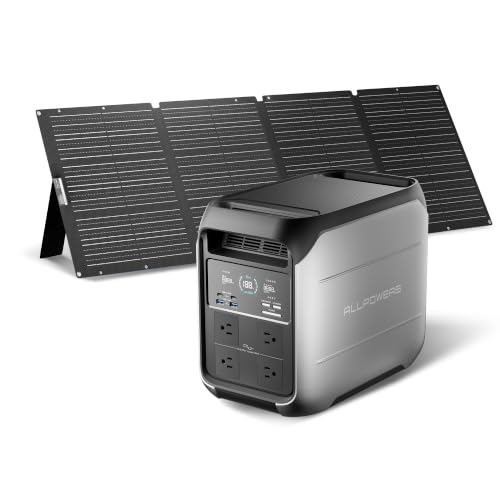
ALLPOWERS P1800 1024Wh LiFePO4
Best for: campers needing fast recharge and UPS backup
- Running Wattage
- 1600 W
- Surge Wattage
- 3200 W
- Capacity
- 1056 Wh
- Battery Chemistry
- LiFePO4
- Output Ports
- 4x AC, 2x USB-C, 2x USB-A, 1x 12V
- Voltage
- 120V
View on Amazon: ALLPOWERS P1800 1024Wh LiFePO4 Affiliate link
The ALLPOWERS P1800 is a 1024Wh portable power station paired with a 200W foldable solar panel. It features a LiFePO4 battery and 1600W AC output. You get ultra-fast wall charging at 80% in 40 minutes and solar charging up to 650W. The unit includes a 15ms UPS function for sensitive devices. This setup suits outdoor camping, road trips, and home backup needs where reliable, rapid power replenishment is key.
Pros
- 1024Wh LiFePO4 battery capacity
- 1600W AC output with 3200W peak
- 80% charge in 40 minutes via wall outlet
- 15ms seamless UPS function
- 200W foldable solar panel included
Cons
- Smaller 1024Wh capacity compared to the 1920Wh competitor
- Lower 200W solar input limit versus higher-wattage options
- Larger physical footprint at 16.3 inches tall
Good fit if
- You need rapid wall charging for quick turnarounds
- You require a UPS function for sensitive electronics
- You want a complete solar-ready kit for camping
Skip if
- You need maximum energy storage for long off-grid stays
- You prefer a more compact unit for tight spaces
- You want higher solar input for faster solar charging
Verdict: The ALLPOWERS P1800 Solar Generator 1024Wh offers fast charging and reliable backup power for users who prioritize speed and device protection over raw capacity.
Specifications side by side
| Spec | ALLPOWERS R2500 V2 with 160W Solar Panel | ALLPOWERS P1800 1024Wh LiFePO4 |
|---|---|---|
| Running Wattage | 2500W | 1600 W |
| Surge Wattage | 5000W | 3200 W |
| Capacity | 1920Wh | 1056 Wh |
| Battery Chemistry | LiFePO4 | LiFePO4 |
| Output Ports | 13 versatile output ports | 4x AC, 2x USB-C, 2x USB-A, 1x 12V |
| Voltage | not stated | 120V |
| Solar Panel Wattage | 160W | 200 W |
| Wattage | 5000W | 200W |
| Application | Camping, Home, Outdoor, RV | Camping, Outdoor, Travel, Power Outage |
| Panel Type | not stated | Foldable |
| Dimensions | 16.7 × 14.2 × 13.6 inches | 12.3 × 10.4 × 16.3 inches |
| Weight | 54 pounds | not stated |
| Color | R2500+SE160(160W) | R1500 LITE+SE200 |
| Model | R2500 V2+SE160 | R1500 LITE+SE200 |
Frequently asked questions
Which unit is lighter and easier to carry?
The ALLPOWERS P1800 is the more portable option. It weighs significantly less than the R2500 V2, which tips the scales at 54 pounds. The P1800 lacks a published weight in the data, but its smaller dimensions of 10.4 by 12.3 by 16.3 inches suggest it is designed for easier transport. This makes it better for campers who need to move gear frequently.
Does the P1800 have a USB-C port?
Yes, the ALLPOWERS P1800 includes USB-C output ports. This feature allows you to charge modern laptops and smartphones directly with high-speed connectivity. The R2500 V2 data does not list specific output port types, so you cannot confirm if it includes USB-C from the provided specifications. If USB-C is essential for your devices, the P1800 offers this capability.
How do the physical sizes compare?
The R2500 V2 is larger in every dimension. It measures 14.2 inches wide, 16.7 inches long, and 13.6 inches high. The P1800 is more compact, measuring 10.4 inches wide, 12.3 inches long, and 16.3 inches high. The P1800 is taller but narrower and shorter in length, making it easier to fit into tighter storage spaces or vehicle compartments.
Can I use these for RV trips?
Both units are suitable for RV use. The R2500 V2 is specifically recommended for RVs due to its high 1920Wh capacity and ability to run heavy appliances. The P1800 is also listed for travel and outdoor applications. Its 1024Wh capacity provides reliable backup power for smaller RV setups or overnight camping trips where weight and space are limited.
What battery chemistry do they use?
Both power stations use LiFePO4 battery chemistry. This type of lithium iron phosphate battery is known for safety and a long cycle life. The R2500 V2 is described as having a durable LiFePO4 battery. The P1800 also explicitly lists LiFePO4 in its attributes. This common chemistry ensures both units offer stable performance and resistance to overheating during use.
Which solar panel is included?
The R2500 V2 comes with a 160W solar panel, identified as the SE160. The P1800 data references an SE200, suggesting it pairs with a 200W foldable panel. The P1800 is explicitly described as having a foldable panel type. This makes it convenient for outdoor setup. The R2500 V2 focuses on higher capacity rather than just panel wattage in its naming.
Is the P1800 good for UPS backup?
Yes, the P1800 is recommended for UPS backup applications. Its 1024Wh capacity provides reliable power during outages. The data highlights its suitability for power outages and device protection. While the R2500 V2 offers more total energy, the P1800 is tailored for users who prioritize fast recharge and reliable backup for essential electronics rather than running heavy loads for extended periods.