Anker or EBL? Generators Compared in 2026
As an Amazon Associate we earn from qualifying purchases. Links on this page are affiliate links.
The anker vs EBL generator comparison highlights two distinct power solutions for different needs. Both units provide clean, silent energy without gas or fumes, making them suitable for home backups and outdoor use. The primary difference lies in scale and longevity. The Anker SOLIX S2000 offers high capacity and long-term durability for essential home appliances. The EBL 500W provides a lightweight, compact option for camping and smaller devices. You should choose based on your power requirements.
Key differences
| Aspect | Anker SOLIX S2000 with Alternator Charger | EBL 500W 519Wh Portable Power Station |
|---|---|---|
| Running Wattage | 1,500 W | 500 W |
| Surge Wattage | 3,000 W | 1,000 W |
| Capacity | Not listed | 519.48 Wh |
| Battery Chemistry | LFP | Lithium |
| Weight | 35.7 pounds | 18 pounds |
| Recharge Methods | 6 ways, including alternator charger | 3 ways, including solar and car outlet |
Which one should you choose?
Choose Anker SOLIX S2000 with Alternator Charger if
- You need to run high-wattage home essentials like refrigerators during outages.
- You want a battery with a 10,000-cycle lifespan for long-term reliability.
- You require multiple charging options, including an alternator charger for vehicles.
Choose EBL 500W 519Wh Portable Power Station if
- You prioritize a lightweight unit for easy transport to campsites.
- You only need to power small electronics, laptops, or CPAP machines.
- You want a simpler setup with fewer outlets and a lower capacity.
Verdict: The Anker SOLIX S2000 is the better choice for home backup due to its higher wattage and durable LFP battery. The EBL 500W suits outdoor enthusiasts who need a portable, lightweight station for small devices. Select the Anker for power and longevity, or the EBL for portability and simplicity.
Anker SOLIX S2000 vs EBL 500W
Running wattage
The Anker SOLIX S2000 delivers 1,500 watts of continuous power, allowing you to run larger appliances like small air conditioners or multiple devices simultaneously. In contrast, the EBL 500W provides only 500 watts of running power. This lower limit means the EBL unit is best suited for charging phones, laptops, and small electronics, but it cannot handle higher-demand tools or appliances. If you need to power more than basic gadgets, the Anker unit offers significantly more capacity for your everyday needs.
Surge wattage
When starting motors or compressors, devices often require a brief spike in power. The Anker SOLIX S2000 handles up to 3,000 watts of surge power, which helps it start items like refrigerators or power tools that draw extra energy initially. The EBL 500W offers a 1,000-watt surge limit. While this is sufficient for small devices, it is much lower than the Anker. For users who plan to run equipment with startup spikes, the Anker provides a wider safety margin and greater versatility.
Battery capacity
Capacity determines how long your devices stay powered. The Anker SOLIX S2000 features a large 2,000Wh battery system, which the brand states can keep a fridge running for 35 hours. The EBL 500W contains 519.48Wh of storage. This smaller capacity makes the EBL ideal for short camping trips or emergency phone charging, but it will drain much faster than the Anker. If you need to power larger loads for extended periods, the Anker holds significantly more energy.
Battery chemistry
The Anker SOLIX S2000 uses Lithium Iron Phosphate (LFP) cells, which are known for their stability and long cycle life. The manufacturer specifies a 10,000-cycle lifespan, equating to roughly 15 years of use. The EBL 500W lists its battery chemistry simply as lithium, without specifying the exact type or cycle count. LFP batteries generally offer better thermal stability and longer durability compared to standard lithium-ion variants. For long-term reliability and fewer replacements, the Anker has a clear technical advantage.
Weight and size
Portability is a key factor for outdoor use. The EBL 500W weighs just 18 pounds and measures 11.5 by 7.9 by 7.9 inches, making it easy to carry in a car trunk or pack for camping. The Anker SOLIX S2000 is much heavier at 35.7 pounds and larger in dimensions. While the Anker offers more power, its size makes it less convenient for frequent transport. If you prioritize a lightweight, compact unit for hiking or tailgating, the EBL is the better choice.
Recharge options
The Anker SOLIX S2000 supports six ways to recharge, including AC, solar, generator, car outlet, and an included alternator charger. It also accepts up to 400W of solar input. The EBL 500W offers three methods: solar, car outlet, and wall outlet. It supports up to 100W solar input. The Anker provides more flexibility for recharging in various scenarios, especially with the alternator charger option for vehicle-based power. The EBL covers basic needs but lacks the advanced charging versatility of the Anker.
Which portable power station fits your needs?
Homeowners needing long-term backup power
The Anker SOLIX S2000 offers 1,500W continuous output and 3,000W surge power. Its 10,000-cycle LFP battery provides a 15-year lifespan. You can recharge via alternator, solar, or AC. This setup keeps essential appliances running for extended outages without frequent replacements.
Campers seeking lightweight and portable energy
The EBL 500W weighs only 18 pounds and measures 7.9 by 7.9 inches. It delivers 500W running power and 1,000W surge. This compact size fits easily in a car. You get USB-C PD and wireless charging for quick device top-ups on trips.
Users requiring versatile charging options
The EBL unit supports solar, car, and wall outlet charging. It features multiple outputs including USB-A QC 3.0 and USB-C PD 60W. You can power small appliances and charge phones simultaneously. The pure sine wave ensures safe operation for sensitive electronics.
The products compared

Anker SOLIX S2000 with Alternator Charger
Best for: Long-term home backup with alternator charging
- Running Wattage
- 1,500W
- Surge Wattage
- 3,000W
- Capacity
- 2,010Wh
- Battery Chemistry
- LiFePO4
- Output Ports
- 8 outlets
- Application
- Home, Outdoor, Emergency
View on Amazon: Anker SOLIX S2000 with Alternator Charger Affiliate link
The Anker SOLIX S2000 offers 1,500W continuous output and 3,000W surge wattage to power home essentials. Its 314Ah LFP battery provides a 15-year lifespan with 10,000 charge cycles. The unit supports up to 400W solar input and includes an alternator charger for extended backup. Weighing 35.7 pounds, it features eight outlets for flexible device connections.
Pros
- 1,500W continuous and 3,000W peak output
- 10,000-cycle LFP battery with 15-year lifespan
- Supports up to 400W solar input
- Includes alternator charger for extended runtime
- Eight outlets with front and rear placement
Cons
- No 12V DC port available
- Alternator Charger ships in a separate package
- Weighs 35.7 pounds, making it less portable
Good fit if
- You need long-term battery longevity
- You want to charge via a car alternator
- You require high surge wattage for appliances
Skip if
- You need a 12V DC outlet
- You prefer a single-box delivery
- You need a lighter unit under 30 pounds
Verdict: Anker SOLIX S2000 Portable Power Station suits users prioritizing battery lifespan and alternator charging over compact portability or direct DC connections.
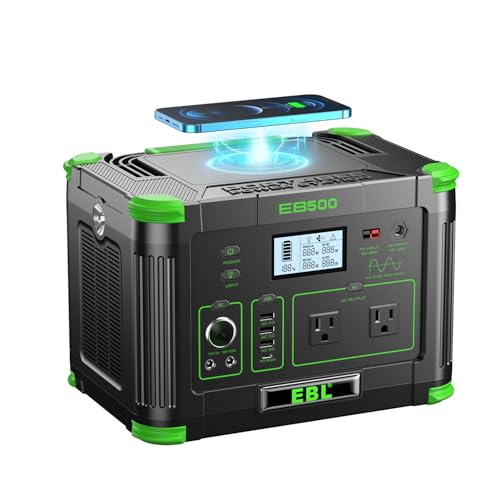
EBL 500W 519Wh Portable Power Station
Best for: camping and CPAP use
- Running Wattage
- 500 W
- Surge Wattage
- 1000 W
- Capacity
- 519.48 Wh
- Battery Chemistry
- Lithium
- Voltage
- 120V
- Application
- Camping, Outdoor, Emergency
View on Amazon: EBL 500W 519Wh Portable Power Station Affiliate link
The EBL 500W offers 519.48Wh of lithium battery capacity in a 14.1-pound unit. It delivers 500W continuous and 1000W surge power via pure sine wave AC outlets. You can recharge it from a wall outlet, solar panel, or car port. This model suits campers needing silent energy for small appliances, CPAP machines, or laptops during outdoor trips.
Pros
- 519.48Wh lithium battery capacity
- 500W continuous and 1000W surge output
- Pure sine wave AC inverter
- Multiple charging methods including solar and car port
Cons
- 500W running wattage limits high-draw appliances
- 14.1-pound weight adds bulk for hiking
- Solar panel sold separately
Good fit if
- You need silent power for CPAP machines
- You want to charge laptops and phones off-grid
- You are camping and can carry 14 pounds
Skip if
- You plan to run a mini-fridge continuously
- You need more than 500W of continuous power
- You require a solar panel included in the box
Verdict: EBL 500W Portable Power Station provides reliable, silent energy for low-power devices. It fits campers who prioritize capacity and charging flexibility over raw wattage.
Specifications side by side
| Spec | Anker SOLIX S2000 with Alternator Charger | EBL 500W 519Wh Portable Power Station |
|---|---|---|
| Running Wattage | 1,500W | 500 W |
| Surge Wattage | 3,000W | 1000 W |
| Capacity | 2,010Wh | 519.48 Wh |
| Battery Chemistry | LiFePO4 | Lithium |
| Output Ports | 8 outlets | not stated |
| Voltage | not stated | 120V |
| Wattage | 500W | 1000W |
| Application | Home, Outdoor, Emergency | Camping, Outdoor, Emergency |
| Dimensions | 11.1 × 8.19 × 12.7 inches | 11.5 × 7.9 × 7.9 inches |
| Weight | 35.7 pounds | 18 pounds |
| Color | Black | Dark Green |
| Model | AS220 | EB500 |
| Size | not stated | 500W |
Frequently asked questions
Which portable power station is better for long-term home backup?
The Anker SOLIX S2000 is the better choice for home backup. It features a 10,000-cycle LFP battery designed for a 15-year lifespan. You can recharge it via an alternator, solar panels, or AC outlets. This durability makes it ideal for users prioritizing longevity over compact size.
Is the EBL 500W suitable for camping trips?
Yes, the EBL 500W is well-suited for camping. It provides 519.48Wh of capacity and 1,000W of peak wattage. The unit weighs only 18 pounds and measures 11.5 inches in length. Its compact size and silent operation make it practical for powering low-demand devices outdoors.
Can the Anker SOLIX S2000 charge from a car?
Yes, the Anker SOLIX S2000 supports alternator charging. This feature allows you to recharge the battery using your vehicle’s alternator. It is particularly useful for long-term home backup scenarios where you need reliable recharging options beyond solar or wall outlets.
How heavy is the EBL 500W portable power station?
The EBL 500W weighs 18 pounds. It measures 7.9 inches in width and height, with a length of 11.5 inches. This lightweight design makes it easy to carry for camping or outdoor use compared to heavier, higher-capacity units.
What is the continuous wattage of the Anker SOLIX S2000?
The Anker SOLIX S2000 delivers 1,500 watts of continuous power. It also offers 3,000W of surge power. This output allows you to run larger appliances like small air conditioners or multiple devices simultaneously, making it more powerful than the EBL 500W.
Does the EBL 500W work with CPAP machines?
Yes, the EBL 500W is suitable for CPAP use. It provides 519.48Wh of capacity, which is sufficient for low-power medical devices. The unit operates silently, ensuring a peaceful environment for users who need reliable power while camping or during outages.
Which generator has a longer battery lifespan?
The Anker SOLIX S2000 has a longer battery lifespan. It uses an LFP battery with a 10,000-cycle rating, providing a 15-year lifespan. The EBL 500W is designed for lower-power, portable applications and does not specify the same long-term cycle durability.
What is the peak wattage of the EBL 500W?
The EBL 500W has a peak wattage of 1,000W. It provides 500 watts of continuous running power. This makes it adequate for charging phones, running lights, or powering small fans, but not for high-draw appliances like large air conditioners.