Panel Type in Generators: What It Is and Is It Worth It?
As an Amazon Associate we earn from qualifying purchases. Links on this page are affiliate links.
Panel Type Explained for Buyers
Understanding panel type explained helps you match solar input to your power needs. This spec defines the physical construction and light-capturing method of attached or compatible solar arrays. Manufacturers label these units to indicate flexibility, durability, and efficiency under varying conditions. You should check the listing details to see which category your station supports.
Foldable panels are the most common choice. They consist of rigid or semi-rigid cells mounted on a hinged frame. You unfold them to create a flat surface for maximum sun exposure. The frame protects the cells during transport. These panels offer a balance of portability and robustness. They are easy to set up on flat ground or a table.
Bifacial panels capture sunlight from both sides. The front absorbs direct light, while the rear captures reflected light from the ground or nearby surfaces. This design can increase energy yield by ten to twenty percent in bright conditions. You need a reflective surface beneath the panel to benefit. This type is ideal for outdoor camping where ground reflection is strong.
Flexible panels use thin film cells bonded to a lightweight substrate. They bend to fit curved surfaces like RV roofs or boat decks. The lack of a rigid frame reduces weight and profile. However, they are more prone to damage if folded incorrectly. You must handle them with care to avoid cracking the internal connections.
Blanket panels are made of soft, fabric-like material. They are extremely lightweight and pack into a small pouch. You can drape them over uneven terrain or tree branches. The efficiency is generally lower than rigid options due to less optimal cell alignment. They are best for emergency kits or ultralight backpacking where every ounce matters.
Choosing the right type depends on your usage. Foldable panels suit car camping and base camps. Bifacial models work well in open, sunny areas. Flexible and blanket panels are niche solutions for specific mobility constraints. Review the specifications to ensure compatibility with your portable power station's input voltage and amperage limits.
Comparing Solar Panel Types
Foldable
Foldable panels use rigid cells mounted on flexible fabric or plastic sheets. You can roll them up for transport and unroll them to catch sunlight. This design balances portability with decent durability. It suits campers and hikers who need lightweight gear that packs small. The trade-off is that the cells are more exposed to wear than hard panels. The MARBERO M823 includes a 60W foldable panel, making it a practical starter kit for light users. It offers basic portability and included solar charging for small devices. You get easy setup without heavy frames. However, the fabric base offers less protection against impacts than rigid alternatives. This type is ideal when weight and packed size matter more than raw power output.
Bifacial
Bifacial panels capture sunlight from both the front and back surfaces. The back side absorbs reflected light from the ground or surrounding surfaces. This increases total energy harvest compared to standard panels. It suits users who value high solar efficiency and long battery life. The setup often requires mounting the panel above a reflective surface to maximize rear-side gain. The trade-off is increased complexity and weight. The EcoFlow DELTA 3 Plus features a 220W bifacial panel. It fits users who prioritize efficiency over portability. Its robust LiFePO4 cells and bifacial design make it ideal for stationary or semi-stationary off-grid setups. You gain more power per square foot but need to manage the heavier, larger components.
Flexible
Flexible panels consist of thin solar cells bonded to a bendable substrate. They conform to curved surfaces like RV roofs or boat decks. This form factor allows installation where rigid panels cannot fit. It suits travelers and van lifers who need permanent or semi-permanent power sources. The trade-off is lower efficiency and higher susceptibility to damage from sharp objects. These panels often lack the ruggedness of hard-frame units. While no specific product in this list highlights a purely flexible panel without other attributes, the general category offers mounting versatility. You sacrifice some durability for the ability to adhere to non-flat surfaces. This makes them a specialized choice for mobile living spaces rather than general camping.
Blanket
Blanket panels are ultra-thin, soft solar arrays that resemble a fabric mat. They are extremely lightweight and pack into a small pouch. This design maximizes portability above all else. It suits minimalists who need to charge phones or small devices on the go. The trade-off is very low power output and minimal durability. They are prone to tearing if folded incorrectly or stepped on. The HOWEASY 260W unit includes a 60W panel described as foldable, which often shares characteristics with blanket-style designs in marketing. It is a practical choice for campers who need to charge phones and laptops without carrying heavy equipment. Its small size makes it ideal for short trips where weight matters more than power. You get convenience but must handle the panel with care.
Is Panel Type Worth Your Money
Who needs it
You should prioritize this spec if you plan to use solar power in dynamic or constrained environments. Foldable panels offer a practical balance for hikers and campers who need to roll up gear for transport but require decent durability when unrolled. Bifacial models are ideal for users in bright, open spaces where light reflects off the ground, effectively doubling energy capture by absorbing light from both sides. Flexible panels are essential for those mounting arrays on curved surfaces, such as van roofs or boat decks, where rigid structures fail. Blanket-style panels suit individuals who need maximum surface area in a compact form, allowing them to drape over objects to catch scattered light. If your setup involves moving locations frequently or utilizing unique mounting surfaces, the physical construction of the panel directly impacts your daily energy yield. These designs solve specific logistical problems that standard rigid panels cannot.
Who can skip it
You can ignore this detail if you primarily use your power station indoors or in a fixed outdoor location with ample space. If you always have a clear, flat area to deploy a standard rigid panel, the unique benefits of flexible or bifacial designs offer little practical advantage. Users who rely on grid charging or generator backup for the majority of their power needs do not need to optimize for solar input variations. The cost and complexity of specialized panel types are unnecessary if you do not engage in activities requiring frequent transport or unconventional mounting. Instead, focus on total wattage and charging speed. A higher output from a standard panel often provides more consistent power than a specialized design with lower efficiency. Prioritize battery capacity and AC output capabilities if your main concern is running high-draw appliances rather than maximizing solar efficiency in tricky conditions.
Panel Type Glossary
Monocrystalline Silicon
High-efficiency cells made from single-crystal wafers. They convert more sunlight to power than other types, ideal for limited roof space.
Polycrystalline Silicon
Cells made from melted silicon fragments. They are less efficient but cheaper to produce, offering a budget-friendly option for solar charging.
Thin-Film Panels
Flexible layers of photovoltaic material deposited on substrates. They are lightweight and bendable, suitable for curved surfaces or backpacks.
Rigid Panels
Solar arrays mounted on sturdy aluminum frames. They offer maximum durability and weather resistance, best for permanent rooftop installations.
Foldable Panels
Rigid cells attached to flexible fabric hinges. They roll up for easy transport and deploy quickly for temporary camping use.
Efficiency Rating
The percentage of sunlight converted into usable electricity. Higher ratings mean more power output from the same surface area.
Quick picks
Our 6 picks

MARBERO 237Wh Power Station with Solar Panel
Best for: Lightweight camping and emergency phone charging
- Panel Type
- Foldable (what this guide is about)
- Running Wattage
- 300W
- Surge Wattage
- 375W
- Capacity
- 237Wh
- Fuel Type
- Battery
- Battery Chemistry
- lithium-ion
View on Amazon: MARBERO 237Wh Power Station with Solar Panel Affiliate link
This MARBERO unit combines a 237Wh lithium-ion battery with a 60W foldable solar panel. It delivers 300W of running power and 375W surge capacity. The included panel uses high-efficiency arrays for reliable off-grid charging. You get multiple output options, including AC, USB-A, and USB-C ports. It is a compact solution for small electronics during camping or emergency preparedness.
Pros
- Includes a 60W foldable solar panel for recharging
- 237Wh lithium-ion battery capacity for portable use
- 300W rated and 375W peak output power
- Multiple charging ports including USB-C PD and AC outlets
- Built-in LED flashlight with strobe and SOS modes
Cons
- 237Wh capacity is small for high-drain appliances
- 60W solar panel charges the battery slowly
- Uses lithium-ion chemistry instead of longer-lasting LiFePO4
Good fit if
- You need a lightweight kit for weekend camping trips
- You primarily charge phones, tablets, and small laptops
- You want a complete system with a panel included
Skip if
- You need to run power tools or heavy appliances
- You require long-term off-grid energy storage
- You prefer LiFePO4 battery chemistry for cycle life
Verdict: MARBERO M823 300W Solar Generator with 60W Panel is a practical starter kit for light users who need basic portability and included solar charging for small devices.
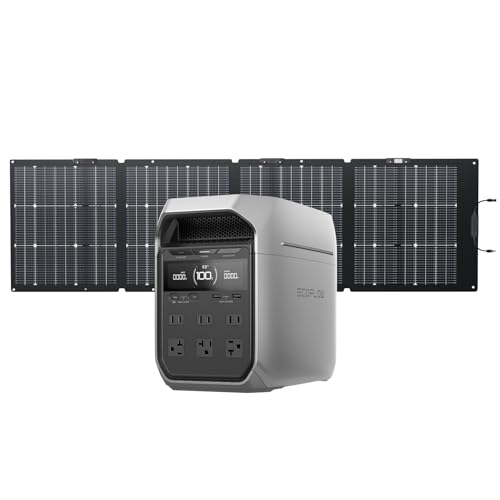
EcoFlow DELTA 3 Plus with 220W Solar Panel
Best for: high-efficiency solar charging and long battery life
- Panel Type
- Bifacial (what this guide is about)
- Running Wattage
- 1800 W
- Capacity
- 1024 Wh
- Battery Chemistry
- LiFePO4 (LFP)
- Output Ports
- 13 ports
- Solar Panel Wattage
- 220 W
View on Amazon: EcoFlow DELTA 3 Plus with 220W Solar Panel Affiliate link
This unit pairs a 1024Wh LiFePO4 battery with a 220W bifacial solar panel. The panel uses N-Type technology for 25% conversion efficiency and captures up to 28% more energy via its dual-sided design. An adjustable bracket helps maintain optimal sunlight angles. You get fast charging options and durable cells rated for 4000 cycles. It suits users needing high capacity and efficient solar input for extended off-grid use.
Pros
- 1024Wh LiFePO4 battery capacity for long-term power.
- 220W bifacial panel with 25% conversion efficiency.
- Dual-sided design collects up to 28% more energy.
- Adjustable 30-60° bracket optimizes solar angle.
- IP65 rating offers splash, dust, and oil protection.
Cons
- 62-pound weight makes it heavy to carry.
- Large dimensions (20x12.2x9.7 inches) require significant storage space.
- Panel and power station ship in separate packages.
Good fit if
- You need high solar input efficiency for quick recharging.
- You require a durable battery with a long cycle life.
- You have space to store a larger, heavier unit.
Skip if
- You prioritize lightweight gear for frequent hiking.
- You need a compact unit for small vehicles.
- You want a single-package delivery for immediate setup.
Verdict: EF Ecoflow DELTA 3 Plus with 220W Bifacial Panel fits users who value high solar efficiency and long battery life over portability. Its bifacial panel and robust LiFePO4 cells make it ideal for stationary or semi-stationary off-grid setups where weight is less critical.

HOWEASY 260W Power Station with 60W Solar Panel
Best for: lightweight camping and travel power
- Panel Type
- Foldable (what this guide is about)
- Running Wattage
- 260W
- Battery Chemistry
- Lithium
- Voltage
- 110V
- Solar Panel Wattage
- 60W
- Application
- Camping, Home, Outdoor, Emergency
View on Amazon: HOWEASY 260W Power Station with 60W Solar Panel Affiliate link
The HOWEASY 260W generator pairs a compact lithium battery with a 60W foldable solar panel. It delivers 260W of running wattage through nine ports, including a 65W Type-C outlet. At 5 pounds, it fits easily in a backpack. This setup suits travelers needing lightweight power for small electronics and camping trips where space is tight.
Pros
- Includes a 60W foldable solar panel for off-grid charging
- Lightweight at 5 pounds with a compact 8.19 x 4.72 x 5.43 inch footprint
- Features a 65W USB-C port for fast laptop charging
- Offers nine output ports including AC, USB, and DC
Cons
- 260W running wattage limits power for high-draw appliances
- No display or indicator for real-time power monitoring
- Solar panel is not bifacial, reducing efficiency in low light
Good fit if
- You need a lightweight power source for backpacking
- You want to charge small devices via a foldable panel
- You prioritize portability over high output capacity
Skip if
- You need to run heavy appliances like refrigerators
- You require high-speed solar recharging with bifacial panels
- You need to power multiple devices simultaneously at high wattage
Verdict: The HOWEASY 260W Foldable Solar Generator is a practical choice for campers who need to charge phones and laptops without carrying heavy equipment. Its small size makes it ideal for short trips where weight matters more than power.

Anker SOLIX C2000 Gen 2 2048Wh Solar Generator
Best for: high surge power and bifacial solar efficiency
- Panel Type
- Bifacial (what this guide is about)
- Running Wattage
- 2,400W
- Surge Wattage
- 4,000W
- Capacity
- 2048Wh
- Battery Chemistry
- LFP
- Solar Panel Wattage
- 200W
View on Amazon: Anker SOLIX C2000 Gen 2 2048Wh Solar Generator Affiliate link
This setup pairs a 2,048Wh power station with a 200W bifacial solar panel. The panel captures sunlight from both sides, adding up to 10% more output than single-sided designs. The station delivers 2,400W of running power and 4,000W peak surge. It recharges fully in 58 minutes via AC or solar. The panel weighs just 10.6 lb and folds for easy transport. You get reliable backup power with efficient solar harvesting.
Pros
- 200W bifacial panel generates up to 10% more power
- 2,400W rated and 4,000W peak output handles heavy loads
- 2,048Wh capacity supports long runtime for appliances
- 100% recharge in 58 minutes via AC or solar
- Panel is IP68 waterproof and only 10.6 lb
Cons
- Solar panel and power station ship in separate packages
- 2,048Wh capacity is smaller than the 2,050Wh competitors
- Requires expansion battery to reach 4kWh capacity
Good fit if
- You need high peak power for appliances like AC units
- You want solar panels that capture rear-side light
- You prioritize fast recharging times under 1 hour
Skip if
- You prefer a single integrated box for portability
- You need more than 2,048Wh without adding extras
- You want a lighter total system weight under 30 lb
Verdict: Anker SOLIX C2000 Gen2 with 200W Bifacial Panel fits users who need high surge power and efficient bifacial solar harvesting. It suits those who value fast recharging and do not mind separate shipping components.

EnginStar 300W Power Station with 60W Solar Panel
Best for: light camping and emergency backup power
- Panel Type
- Foldable (what this guide is about)
- Running Wattage
- 300 W
- Capacity
- 296 Wh
- Battery Chemistry
- Lithium-ion
- Output Ports
- 8 output ports
- Voltage
- 110V
View on Amazon: EnginStar 300W Power Station with 60W Solar Panel Affiliate link
This EnginStar unit pairs a 296Wh lithium-ion battery with a 60W foldable solar panel. It delivers 300W of continuous AC power through pure sine wave outlets. The system includes eight output ports for simultaneous charging. The included panel uses monocrystalline cells for 23% conversion efficiency. This setup suits users needing a lightweight backup source for small electronics and camping gear.
Pros
- 296Wh battery capacity supports multiple device charges
- 60W foldable monocrystalline solar panel included
- 300W continuous AC output with pure sine wave
- Eight output ports including USB-C and DC options
- Weighs only 6.5 pounds for easy transport
Cons
- 296Wh capacity is lower than bifacial competitors
- Lithium-ion chemistry degrades faster than LiFePO4
- 60W solar panel limits fast off-grid recharging
Good fit if
- You need a lightweight power source for short trips
- You want to charge small devices like phones and laptops
- You prefer a complete kit with a solar panel included
Skip if
- You require high-capacity storage for extended off-grid use
- You need long-term battery health with LiFePO4 chemistry
- You plan to power high-wattage appliances like microwaves
Verdict: EnginStar 300W Portable Generator with 60W Foldable Panel is a compact solution for light camping or emergency backup. It fits users who prioritize portability and basic device charging over high capacity or long battery lifespan.

Anker SOLIX F3800 with 400W Bifacial Solar Panel
Best for: High-capacity home backup with efficient solar
- Panel Type
- Bifacial (what this guide is about)
- Running Wattage
- 6,000W
- Capacity
- 3,840Wh
- Battery Chemistry
- LiFePO4
- Voltage
- 120V/240V
- Solar Panel Wattage
- 400W
View on Amazon: Anker SOLIX F3800 with 400W Bifacial Solar Panel Affiliate link
This Anker SOLIX F3800 system pairs a 3,840Wh power station with a 400W bifacial solar panel. The panel uses monocrystalline cells for up to 23% efficiency and offers three angle adjustments. It supports 120V/240V output at 6,000W. The IP67 waterproof design allows outdoor use in rain. It suits users needing high-capacity backup with efficient solar recharging.
Pros
- 400W bifacial solar panel with 23% conversion efficiency
- 3,840Wh base capacity expandable to 26.9kWh
- 6,000W running wattage with 120V/240V dual-voltage output
- IP67 waterproof rating for outdoor reliability
- Three-mode angle adjustment for optimal sun exposure
Cons
- Heavy at 132 pounds
- Large dimensions at 27.6 inches high
- Components ship separately
Good fit if
- You need high-capacity home backup power
- You want efficient solar recharging with bifacial panels
- You require dual-voltage output for appliances
Skip if
- You need a lightweight portable unit
- You prefer a single packaged shipment
- You have limited storage space
Verdict: Anker SOLIX F3800 with 400W Bifacial Panel fits users who prioritize high capacity and dual-voltage output over portability. Its heavy build and large size make it unsuitable for frequent transport, but ideal for stationary backup.
Specifications side by side
| Spec | MARBERO 237Wh Power Station with Solar Panel | EcoFlow DELTA 3 Plus with 220W Solar Panel | HOWEASY 260W Power Station with 60W Solar Panel | Anker SOLIX C2000 Gen 2 2048Wh Solar Generator | EnginStar 300W Power Station with 60W Solar Panel | Anker SOLIX F3800 with 400W Bifacial Solar Panel |
|---|---|---|---|---|---|---|
| Running Wattage | 300W | 1800 W | 260W | 2,400W | 300 W | 6,000W |
| Surge Wattage | 375W | not stated | not stated | 4,000W | not stated | not stated |
| Capacity | 237Wh | 1024 Wh | not stated | 2048Wh | 296 Wh | 3,840Wh |
| Fuel Type | Battery | not stated | not stated | not stated | not stated | not stated |
| Battery Chemistry | lithium-ion | LiFePO4 (LFP) | Lithium | LFP | Lithium-ion | LiFePO4 |
| Output Ports | not stated | 13 ports | not stated | not stated | 8 output ports | not stated |
| Voltage | not stated | not stated | 110V | not stated | 110V | 120V/240V |
| Solar Panel Wattage | 60W | 220 W | 60W | 200W | 60 W | 400W |
| Wattage | 300W | 1800W | not stated | 2400W | 300W | 400W |
| Application | Camping, Outdoor, Emergency, Hiking | Camping, Home, RV | Camping, Home, Outdoor, Emergency | Home, Outdoor, Emergency | Camping, Travel, Power Outage | Home, Outdoor, Emergency, RV |
| Features | not stated | not stated | AC Outlet | not stated | not stated | not stated |
| Panel Type | Foldable | Bifacial | Foldable | Bifacial | Foldable | Bifacial |
| Dimensions | 12 × 10 × 16 inches | 20 × 9.7 × 12.2 inches | 8.71 × 4.72 × 5.43 inches | 18.1 × 9.8 × 10.1 inches | 9.05 × 7.48 × 5.5 inches | 15.6 × 15.3 × 27.6 inches |
| Weight | 9 pounds | 62 pounds | not stated | not stated | not stated | 132 pounds |
| Color | Brick Red Black | silver | Gray Orange | Gray | Green Grey | Black |
| Model | M823SL60 | EF-DL-H10-4 | H260 | A1783 | R300 | A1790 |
| Size | not stated | not stated | not stated | not stated | 300W | not stated |
Frequently asked questions
What is a bifacial solar panel?
A bifacial panel captures sunlight from both its front and back surfaces. This design increases total energy harvest by reflecting light onto the rear cells. You will see this type in high-efficiency kits like the EcoFlow DELTA 3 Plus or Anker SOLIX F3800. These units suit stationary setups where weight is less critical than maximum output.
Are foldable panels durable enough for hiking?
Foldable panels use rigid cells mounted on flexible fabric or plastic sheets. They balance portability with decent durability for outdoor use. You can roll them up for transport and unroll them to catch sunlight. Models like the MARBERO M823 and EnginStar R300 offer this design for campers who need lightweight gear for short trips.
Does panel type affect charging speed?
Yes, the panel type and wattage directly impact how fast you recharge your power station. Bifacial panels often provide higher efficiency by capturing reflected light. For example, the Anker SOLIX C2000 Gen2 uses a 200W bifacial panel for fast recharging. Foldable panels, like the 60W unit on the HOWEASY H260, offer slower but sufficient charging for small devices.
Can I use a bifacial panel on uneven ground?
Bifacial panels work best when positioned to allow light reflection onto their rear side. They are often heavier and less portable than foldable options. The EcoFlow DELTA 3 Plus and Anker SOLIX F3800 feature bifacial panels suited for semi-stationary or home backup setups. You should avoid frequent transport if you choose this type due to their robust build.
What is the difference between foldable and bifacial panels?
Foldable panels prioritize portability with flexible materials, while bifacial panels prioritize efficiency with dual-sided light capture. Foldable units like the EnginStar R300 are compact and light. Bifacial units like the Anker SOLIX F3800 are heavier but harvest more energy. You should choose foldable for hiking and bifacial for stationary home backup or long-term off-grid use.
Do I need a specific panel type for emergency backup?
Your choice depends on whether you need portability or high capacity. Foldable panels suit emergency kits that must be stored easily or carried quickly. The MARBERO M823 is a practical starter kit for emergency phone charging. Bifacial panels offer higher wattage for running more appliances during extended outages, as seen in the Anker SOLIX F3800.