Voltage Explained: What It Means for Solar Panels
As an Amazon Associate we earn from qualifying purchases. Links on this page are affiliate links.
Voltage Explained for Solar Buyers
Voltage is the electrical pressure that pushes current through a circuit. Think of it like water pressure in a pipe. Higher pressure pushes water faster. In solar systems, this pressure determines how efficiently energy moves from the panel to your power station. Understanding voltage explained helps you match components correctly.
Solar panels produce direct current. The voltage rating tells you the potential difference between the positive and negative terminals. When you connect a panel to a battery or inverter, this difference drives the flow of electrons. If the voltage is too low, the current may not reach the threshold needed to charge your device. If it is too high, it can damage sensitive electronics.
You will see specific values on product listings. The most common are 12V, 24V, and 18V. These numbers are nominal ratings. They represent the typical operating point, not the exact output at every moment. An 18V panel is often used for 12V battery systems. The higher open-circuit voltage ensures the panel can still charge the battery even when it is cloudy or cold.
A 24V system is common for larger setups. It allows for thinner wires over longer distances because the current is lower for the same power. This reduces energy loss in the cables. A 5V output is standard for small USB devices. It is not suitable for charging large portable power stations directly.
When buying solar panels, check the maximum power voltage (Vmp) and open-circuit voltage (Voc). Your power station’s input range must accommodate these values. Mismatching voltage can lead to poor charging performance or equipment failure. Always verify that the panel’s voltage aligns with your generator’s input specifications. This simple check ensures your solar setup works reliably every time you need it.
Understanding Solar Panel Voltage Options
12V
12-volt panels are the standard for maintaining single lead-acid or lithium batteries in RVs, boats, and cars. They provide the right electrical pressure to charge these common battery systems without requiring complex voltage conversion. This voltage suits users who need simple, reliable trickle charging for vehicle batteries rather than powering high-demand appliances. The SOLPERK 30W 12V Solar Battery Charger Kit exemplifies this category, offering a practical maintenance solution with included mounting hardware. Its 12V output ensures compatibility with most standard 12V battery banks. You get a straightforward setup that fits users seeking a weather-resistant charger for single battery systems. The trade-off is limited power output for running heavy loads, making it ideal for preservation rather than primary power generation.
24V
24-volt systems are designed for larger battery banks found in off-grid homes and larger RVs. They allow for thinner wiring and lower current for the same power output, reducing energy loss over long distances. This voltage suits users with high power demands who can manage the weight and size of rigid panels. The Callsun 400W Bifacial Solar Panel 2-Pack supports both 12V and 24V systems, delivering strong output for efficient off-grid power. Similarly, the Rvpozwer 200W pair targets 12V and 24V RV battery charging with reliable efficiency. You benefit from scalable power for larger homes or vehicles. The trade-off involves higher initial complexity and the need for compatible charge controllers. These panels fit well where space is tight but power demand is high, requiring careful system planning.
18V
18-volt panels are often labeled as 12V panels because their maximum power voltage is optimized to charge 12V batteries effectively. They typically use monocrystalline cells for durability and waterproofing. This voltage suits users needing a durable, waterproof panel for maintaining 12V batteries in small vehicles like RVs or boats. The ECO-WORTHY 25W Monocrystalline Solar Panel features an 18V output, fitting users who need reliable maintenance power. Its low wattage makes it unsuitable for powering high-demand appliances, but perfect for keeping batteries topped up. You get a compact, lightweight solution that handles outdoor conditions well. The trade-off is the same as other low-wattage panels: limited ability to run devices directly. It is a specialized tool for battery preservation in marine or recreational vehicle environments.
5V
5-volt panels are niche solutions designed specifically for low-voltage USB devices. They output power directly compatible with USB-C or USB-A ports, eliminating the need for converters. This voltage suits owners of specific 5V USB-C security cameras or small electronics that cannot connect to standard 12V or 18V panels. The YCTechCam 5W USB-C Solar Panel provides a dedicated power source where standard panels fail. Its IP65 rating ensures waterproof performance for outdoor security applications. You get a plug-and-play solution for specific devices without complex wiring. The trade-off is extreme specialization; it cannot charge standard 12V batteries or run most other solar-compatible equipment. It is a targeted tool for niche applications, offering simplicity for devices that strictly require 5V input.
Is Voltage Worth Your Attention
Who needs it
You need to pay close attention to voltage if you are building a custom solar setup for an RV, boat, or off-grid cabin. The specific voltage rating of your panel must match the input requirements of your charge controller and battery bank. If you choose a 12V panel, it is ideal for maintaining single lead-acid or lithium batteries in vehicles. However, if you are running a larger system with higher power demands, a 24V panel becomes essential. It provides the necessary electrical pressure to charge larger battery banks efficiently without excessive current loss. Similarly, 18V panels often serve as the optimal bridge for charging 12V batteries from a higher voltage source, ensuring better performance in varying light conditions. Understanding these distinctions ensures your energy system operates safely and effectively, preventing damage to your components.
Who can skip it
You can largely ignore specific voltage ratings if you are buying a pre-built, all-in-one solar kit. These kits come with integrated charge controllers and adapters that automatically handle voltage conversion. You do not need to worry about matching panel outputs to battery inputs because the manufacturer has already solved that problem for you. Instead of focusing on whether a panel is 12V or 24V, prioritize total wattage and portability. Look for panels that offer the highest energy output relative to their size and weight. Also, consider the durability of the frame and the quality of the connectors. For casual users camping with small devices, a simple 5V USB output may be sufficient, removing the need for complex electrical knowledge altogether. Focus on ease of use rather than technical compatibility.
Voltage Glossary Basics
Open Circuit Voltage
The maximum voltage a panel produces when not connected to a load. This value sets the upper limit for your charge controller input requirements.
Maximum Power Voltage
The voltage at which the panel delivers its highest wattage output. You should match this to your inverter or controller for optimal energy harvest.
Series Connection
Linking panels positive-to-negative to add their voltages together. This allows you to reach higher system voltages without increasing the current flow.
Parallel Connection
Connecting all positive terminals together and all negatives together. This keeps the voltage the same while increasing the total current capacity of your array.
MPPT Controller
A charge controller that converts excess voltage into extra current. It allows high-voltage panels to efficiently charge lower-voltage battery banks.
PWM Controller
A simpler controller that connects panels directly to batteries. It requires the panel voltage to closely match the battery voltage for proper charging.
Temperature Coefficient
A rating showing how voltage drops as panels get hotter. Cold weather increases voltage, so you must check this to avoid exceeding controller limits.
Quick picks
| # | Product | Best for | Price |
|---|---|---|---|
| 1 | SOLPERK 30W 12V Solar Battery Charger Kit | 12V battery maintenance and trickle charging | Check price of SOLPERK 30W 12V Solar Battery Charger Kit on Amazon |
| 2 | Callsun 400W Bifacial Solar Panel 2-Pack | high-efficiency off-grid and RV power | Check price of Callsun 400W Bifacial Solar Panel 2-Pack on Amazon |
| 3 | ECO-WORTHY 25W Monocrystalline Solar Panel | maintaining 12V batteries in RVs and boats | Check price of ECO-WORTHY 25W Monocrystalline Solar Panel on Amazon |
| 4 | YCTechCam 5W USB-C Solar Panel | 5V USB-C security cameras | Check price of YCTechCam 5W USB-C Solar Panel on Amazon |
| 5 | Voltset 20W 12V MPPT Solar Maintainer | 12V battery maintenance and trickle charging | Check price of Voltset 20W 12V MPPT Solar Maintainer on Amazon |
| 6 | Rvpozwer 200W 18BB N-Type Solar Panel Pair | 12V and 24V RV battery charging | Check price of Rvpozwer 200W 18BB N-Type Solar Panel Pair on Amazon |
Our 6 picks
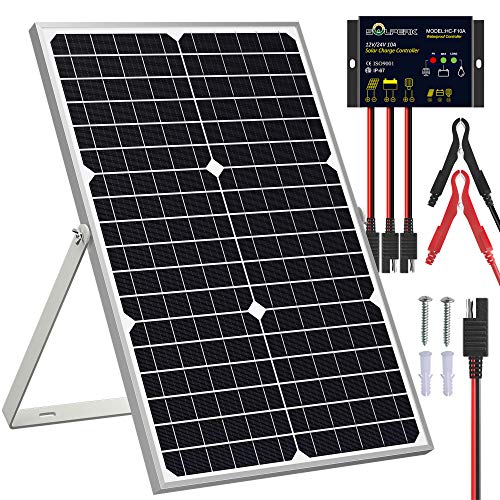
SOLPERK 30W 12V Solar Battery Charger Kit
Best for: 12V battery maintenance and trickle charging
- Voltage
- 12V (what this guide is about)
- Rated Power
- 30W
- System Voltage
- 12V
- Application
- RV, Car, Marine
- Features
- Solar Charging, Charge Controller
- Water Resistance
- Waterproof
View on Amazon: SOLPERK 30W 12V Solar Battery Charger Kit Affiliate link
This SOLPERK kit provides 30W of power at 12V, designed for maintaining batteries rather than high-output charging. It includes a 10A PWM charge controller and an adjustable mounting bracket. The panel features low-iron tempered glass and a corrosion-resistant aluminum frame for weather resistance. You get alligator clips and an SAE extension cable for direct connections. This setup suits users needing a reliable trickle charger for small 12V systems.
Pros
- 30W rated power output at 12V system voltage
- Includes 10A PWM charge controller with three-stage charging
- Adjustable 360-degree mounting bracket for optimal sun angle
- IP65 waterproof controller and weather-resistant panel construction
Cons
- Limited to 12V system voltage, incompatible with 24V setups
- Uses PWM technology, which is less efficient than MPPT
- 30W capacity is low compared to larger 100W or 200W panels
Good fit if
- You need a dedicated trickle charger for a single 12V battery
- You require a compact 30W panel for small maintenance tasks
- You want an all-in-one kit with included mounting hardware
Skip if
- You require 24V compatibility for larger battery banks
- You need high-efficiency MPPT charging for off-grid power
- You require more than 30W of solar input power
Verdict: SOLPERK 30W 12V Solar Panel Kit is a practical maintenance solution for single 12V batteries. It fits users who need a simple, weather-resistant trickle charger with included mounting hardware.

Callsun 400W Bifacial Solar Panel 2-Pack
Best for: high-efficiency off-grid and RV power
- Voltage
- 12V, 24V (what this guide is about)
- Rated Power
- 400W
- Conversion Efficiency
- 25.6%
- Panel Type
- Bifacial
- Cell Type
- N-type monocrystalline
- System Voltage
- 12V/24V
View on Amazon: Callsun 400W Bifacial Solar Panel 2-Pack Affiliate link
This Callsun 200W panel uses N-type monocrystalline cells to reach 25.6% conversion efficiency. It supports 12V and 24V systems and features bifacial technology to capture light from both sides. You can pair two units in series for 400W total output. The design includes TwinCell anti-shading technology and a low temperature coefficient for stable performance in heat. It suits RVs and off-grid setups.
Pros
- 25.6% conversion efficiency with N-type cells
- Bifacial design captures front and rear light
- TwinCell anti-shading maintains power output
- Low temperature coefficient of -0.30%/K
- Supports 12V and 24V systems
Cons
- Requires two panels for 400W output
- Each unit weighs 23.8 pounds
- Fixed dimensions limit flexible mounting
Good fit if
- You need high efficiency for limited roof space
- You operate in hot climates with stable output needs
- You use 12V or 24V portable power stations
Skip if
- You require a single lightweight panel under 20 pounds
- You need a flexible or curved panel design
- You only have a 5V input limit
Verdict: Callsun 200W Bifacial Solar Panel delivers strong output for users who can manage the weight and size of rigid panels. It fits well in RVs or off-grid homes where space is tight but power demand is high.

ECO-WORTHY 25W Monocrystalline Solar Panel
Best for: maintaining 12V batteries in RVs and boats
- Voltage
- 12V, 18V (what this guide is about)
- Rated Power
- 25W
- Cell Type
- Monocrystalline
- System Voltage
- 18V
- Weight
- 3.1 pounds
- Application
- RV, Off-Grid, Car, Marine
View on Amazon: ECO-WORTHY 25W Monocrystalline Solar Panel Affiliate link
This ECO-WORTHY panel delivers 25W of power using monocrystalline cells. Its 18V system voltage is designed to charge 12V batteries in RVs, boats, and trailers. The unit weighs 4.54 pounds and measures 16.5 by 12.6 inches. It includes a 39.3-inch extension cable and features a waterproof junction box. This setup suits you if you need a compact, durable source for maintaining small battery banks.
Pros
- Monocrystalline cells for efficient energy conversion
- 18V output optimized for 12V battery systems
- Waterproof junction box and corrosion-resistant frame
- Includes 39.3-inch extension cable for flexible placement
- Withstands 2400Pa wind and 5400Pa snow loads
Cons
- Low 25W rated power limits charging speed
- Small surface area restricts total daily energy harvest
- 18V voltage requires compatible charge controller for 12V batteries
Good fit if
- You need a lightweight panel for RV or boat maintenance
- You require a waterproof unit for outdoor marine use
- You want a compact panel with a long extension cable
Skip if
- You need high wattage for primary power generation
- You require a 12V panel without voltage conversion
- You need a kit with an included charge controller
Verdict: ECO-WORTHY 25W 18V Monocrystalline Solar Panel fits users needing a durable, waterproof panel for maintaining 12V batteries in small vehicles. Its low wattage makes it unsuitable for powering high-demand appliances.

YCTechCam 5W USB-C Solar Panel
Best for: 5V USB-C security cameras
- Voltage
- 5V (what this guide is about)
- Rated Power
- 5W
- Cell Type
- Monocrystalline
- System Voltage
- DC 5V
- IP Rating
- IP65
- Weight
- 7.84 oz
View on Amazon: YCTechCam 5W USB-C Solar Panel Affiliate link
This is a 5W monocrystalline solar panel designed for 5V security cameras. It features a USB-C output and an IP65 waterproof rating for outdoor use. The unit includes a 360-degree adjustable wall bracket. It weighs 7.84 ounces and measures 6.5 by 7.28 inches. You should choose this if your camera requires a direct 5V connection via USB-C rather than a standard 12V or 18V system.
Pros
- DC 5V system voltage matches specific camera inputs
- USB-C output port for direct connection
- IP65 waterproof rating for outdoor durability
- Monocrystalline silicon cells for stable power supply
- Includes 360-degree adjustable wall mounting bracket
Cons
- Low 5W rated power limits charging speed
- Only compatible with USB-C or micro USB cameras
- Does not support Arlo, Blink, Ring, or other proprietary brands
Good fit if
- You need a dedicated 5V power source for a USB-C security camera
- You want a lightweight panel that weighs under 8 ounces
- You require an IP65 waterproof rating for outdoor installation
Skip if
- You need to charge 12V or 24V batteries
- Your camera requires a proprietary brand-specific solar kit
- You need high wattage for fast charging or multiple devices
Verdict: YCTechCam 5W 5V USB-C Solar Panel is a niche solution for owners of specific 5V USB-C security cameras. It provides a dedicated power source where standard 12V or 18V panels cannot connect directly.
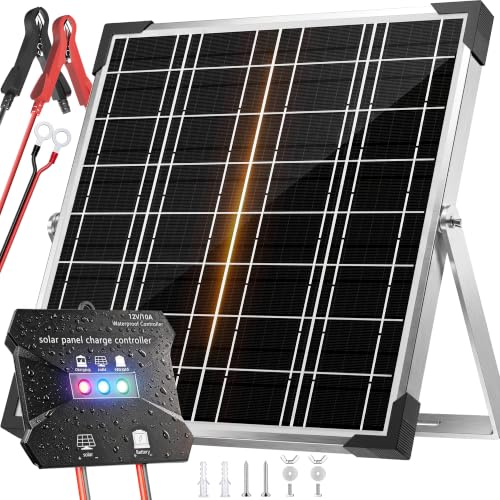
Voltset 20W 12V MPPT Solar Maintainer
Best for: 12V battery maintenance and trickle charging
- Voltage
- 12V (what this guide is about)
- Rated Power
- 20W
- Cell Type
- A+ monocrystalline
- System Voltage
- 12V
- IP Rating
- IP67
- Weight
- 4 pounds
View on Amazon: Voltset 20W 12V MPPT Solar Maintainer Affiliate link
This is a 20W monocrystalline solar panel designed for 12V battery systems. It includes an MPPT controller to improve charging speed by 20-30% compared to basic models. The unit weighs 4 pounds and measures 15 by 13.6 inches. It features IP67 waterproofing to handle rain and snow. You will find this kit suitable for maintaining car, RV, or boat batteries without complex installation.
Pros
- 20W rated power output
- MPPT controller for faster charging
- IP67 waterproof rating
- Monocrystalline cell type
- Universal 12V battery compatibility
Cons
- Low 20W capacity limits fast charging
- Fixed 12V system voltage only
- No Bluetooth or app connectivity
Good fit if
- You need a simple trickle charger for a 12V battery
- You want a lightweight panel for a boat or trailer
- You prefer plug-and-play installation without tools
Skip if
- You require 24V system compatibility
- You need high power for primary energy generation
- You want remote monitoring via an app
Verdict: Voltset 20W 12V Solar Panel Kit is a compact maintenance solution for 12V batteries. It fits users who need reliable trickle charging for RVs or boats rather than primary power generation.

Rvpozwer 200W 18BB N-Type Solar Panel Pair
Best for: 12V and 24V RV battery charging
- Voltage
- 12V, 24V (what this guide is about)
- Rated Power
- 100 W
- Conversion Efficiency
- Up to 25%
- Cell Type
- N-Type monocrystalline
- System Voltage
- 12V/24V
- Busbar Count
- 18BB
View on Amazon: Rvpozwer 200W 18BB N-Type Solar Panel Pair Affiliate link
This Rvpozwer kit includes two 100-watt panels rated for 12-volt or 24-volt systems. It uses N-Type monocrystalline cells with an 18BB design to reach 25% conversion efficiency. The panels weigh 10.8 pounds each and feature an aluminum frame with tempered glass. You get solid power output for RVs or off-grid setups, though the 100-watt rating is modest compared to higher-capacity options on this list.
Pros
- 25% conversion efficiency with N-Type monocrystalline cells
- 18BB busbar design for improved current collection
- Compatible with both 12V and 24V systems
- Includes two 100W panels for higher total output
Cons
- 100W per panel is lower power than the 400W option
- 10.8 lb weight per panel adds bulk for transport
- No mention of included charge controller or wiring harness
Good fit if
- You need a 12V or 24V system for an RV
- You want high-efficiency N-Type cells for limited space
- You prefer a standard 100W panel size for easy mounting
Skip if
- You require a high-power 400W panel for fast charging
- You need a complete kit with an included charge controller
- You are looking for a lightweight 5V or 18V panel
Verdict: Rvpozwer 100W 12V/24V N-Type Solar Panel delivers reliable 25% efficiency for 12-volt and 24-volt users. It fits well for RV owners who prioritize cell technology over raw wattage.
Specifications side by side
| Spec | SOLPERK 30W 12V Solar Battery Charger Kit | Callsun 400W Bifacial Solar Panel 2-Pack | ECO-WORTHY 25W Monocrystalline Solar Panel | YCTechCam 5W USB-C Solar Panel | Voltset 20W 12V MPPT Solar Maintainer | Rvpozwer 200W 18BB N-Type Solar Panel Pair |
|---|---|---|---|---|---|---|
| Rated Power | 30W | 400W | 25W | 5W | 20W | 100 W |
| Conversion Efficiency | not stated | 25.6% | not stated | not stated | not stated | Up to 25% |
| Panel Type | not stated | Bifacial | not stated | not stated | not stated | not stated |
| Cell Type | not stated | N-type monocrystalline | Monocrystalline | Monocrystalline | A+ monocrystalline | N-Type monocrystalline |
| System Voltage | 12V | 12V/24V | 18V | DC 5V | 12V | 12V/24V |
| Busbar Count | not stated | 16BB | not stated | not stated | not stated | 18BB |
| IP Rating | not stated | IP68 | not stated | IP65 | IP67 | not stated |
| Weight | not stated | 23.8 pounds | 3.1 pounds | 7.84 oz | 4 pounds | 10.8 lbs |
| Wattage | 30W | 200W | 25W | not stated | 20W | 200W |
| Application | RV, Car, Marine | Home, RV, Off-Grid, Marine | RV, Off-Grid, Car, Marine | Outdoor | RV, Car, Marine | Home, RV, Off-Grid, Marine |
| Features | Solar Charging, Charge Controller | not stated | not stated | Solar Charging | Charge Controller | Solar Charging |
| Voltage | 12V | 12V, 24V | 12V, 18V | 5V | 12V | 12V, 24V |
| Output Ports | not stated | not stated | not stated | USB-C | not stated | not stated |
| Water Resistance | Waterproof | not stated | Waterproof | Waterproof | Waterproof | not stated |
| Dimensions | 21.3 × 13.6 × 0.7 inches | 51.3 × 30.3 × 1.38 inches | 16.5 × 12.6 × 0.7 inches | 7.28 × 6.5 × 0.59 inches | 15 × 13.6 × 1.69 inches | 26.4 × 1.18 × 52.8 inches |
| Size | 30W PWM+Load Kit | 200W 2-Pack Black | 25W Panel | Pack of 1 | 20W Smart MPPT | not stated |
| Color | Black | Black | blue-black | not stated | Silver | Black |
| Model | SOLPERK | CN200W | AM-L02M25-1 | SP-L50 | VS-20W | 1507 |
Frequently asked questions
Can I use a 12V solar panel on a 24V battery system?
You generally cannot connect a standard 12V panel directly to a 24V battery. The electrical pressure is too low to charge the higher-voltage bank effectively. Some panels, like the Callsun 400W Bifacial or Rvpozwer 200W models, support both 12V and 24V systems. These versatile units adapt to your battery type, allowing you to charge either system without needing complex converters.
Why do 12V panels often show 18V on the label?
The 18V rating is the maximum power voltage, which is higher than the 12V battery nominal voltage. This extra pressure ensures the panel can push current into a 12V battery even in suboptimal light. For example, the ECO-WORTHY 25W Monocrystalline panel is labeled 18V but is designed for 12V maintenance. This difference allows efficient charging across varying weather conditions.
Is a 5V solar panel useful for anything other than phones?
Yes, 5V panels serve niche applications like security cameras that require specific USB-C power inputs. The YCTechCam 5W USB-C Solar Panel is built for this exact purpose. It provides a dedicated power source for devices that cannot accept standard 12V or 18V inputs. This makes it ideal for outdoor security setups where standard solar gear does not fit.
Do bifacial panels work better in 12V or 24V systems?
Bifacial panels like the Callsun 400W Bifacial are designed to work with both 12V and 24V systems. Their dual-sided design captures more light, increasing overall efficiency regardless of the battery voltage. They are particularly useful in RVs or off-grid homes where space is tight but power demand is high. The voltage compatibility ensures they integrate smoothly into your existing electrical setup.
What is the difference between MPPT and PWM voltage handling?
MPPT controllers, like the one in the Voltset 20W kit, adjust voltage to maximize power harvest from the panel. PWM controllers simply match the panel voltage to the battery. The Voltset 20W Smart MPPT maintainer optimizes trickle charging for 12V batteries. This technology ensures you get the most energy from your panel, even if the voltage fluctuates during the day.
Can I chain multiple 12V panels to get higher voltage?
You can connect panels in series to increase voltage, but you must check the total open circuit voltage. The Callsun 200W Bifacial panels come in a 2-pack, which may allow for series connections if your charge controller supports the combined voltage. Always ensure the total voltage stays within your controller's input limits to avoid damage. This method helps when you need higher pressure for 24V systems.