Westinghouse or Generac? Generators Compared in 2026
As an Amazon Associate we earn from qualifying purchases. Links on this page are affiliate links.
The westinghouse vs generac generator comparison highlights two heavy-duty options for home backup. Both units deliver around 12,500 peak watts and feature electric start systems. They share similar physical footprints and voltage outputs. The main difference lies in fuel flexibility. The Westinghouse model uses dual fuel, while the Generac unit supports tri fuel with natural gas connectivity. You need to weigh these fuel options against your specific power needs.
Key differences
| Aspect | Westinghouse 12500-Watt Dual-Fuel Generator | Generac 12,500W Tri-Fuel Generator with EFI |
|---|---|---|
| Fuel Type | Dual Fuel (Gas/Propane) | Tri Fuel (Gas/Propane/Natural Gas) |
| Running Watts (Gas) | 9,500 W | 12,500 W |
| Running Watts (Propane) | 8,500 W | 8,550 W |
| Running Watts (Natural Gas) | Not listed | 7,000 W |
| Start Type | Electric, Remote, Recoil | Electric, Recoil |
| Safety Feature | Low Oil Shutdown | CO Sense Technology |
Which one should you choose?
Choose Westinghouse 12500-Watt Dual-Fuel Generator if
- You need higher running wattage on gasoline for heavy loads
- You prefer remote start capability with a key fob
- You want a digital display showing real-time voltage and hours
Choose Generac 12,500W Tri-Fuel Generator with EFI if
- You want to connect directly to your home's natural gas line
- You prioritize automatic carbon monoxide detection and shutdown
- You need a built-in wheel kit for easier mobility
Verdict: Choose the Westinghouse if you prioritize peak gasoline wattage and remote start convenience. Select the Generac if you want the flexibility of natural gas connection and enhanced safety monitoring with CO Sense. Both units offer robust power for home backup scenarios.
Westinghouse vs Generac Generator Specs
Fuel flexibility
The Generac 12,500 Watt Tri-Fuel Generator offers three fuel options: gasoline, liquid propane, and natural gas. A single dial allows you to switch sources without shutting down the unit. The Westinghouse 12500 Watt Dual Fuel model supports only gasoline and propane. While both provide dual-fuel capability, the Generac adds natural gas connectivity for permanent home lines. This extra option gives the Generac a slight advantage for users seeking maximum fuel source versatility during extended outages.
Wattage output
Both generators share the same 12,500 peak watt rating on gasoline. However, their running watts differ slightly. The Westinghouse delivers 9,500 running watts on gas and 8,500 on propane. The Generac provides 8,550 running watts on propane and 7,000 on natural gas. The Westinghouse maintains a higher running wattage on propane, which matters for sustained loads. The Generac lacks a specific gasoline running watt figure in the data, but its propane output is marginally lower. The Westinghouse holds a narrow edge in consistent power delivery.
Safety technology
The Generac includes COSENSE Technology, which continuously monitors carbon monoxide levels. It triggers an audible alert and automatically shuts down the generator before dangerous concentrations build. The Westinghouse features an Automatic Low Oil Shutdown and a Digital Hour Meter, but the data does not list a built-in carbon monoxide sensor. The Generac’s active CO detection provides a clear safety advantage for indoor-adjacent use or poorly ventilated areas, offering peace of mind that the Westinghouse model does not explicitly provide in its specifications.
Engine maintenance
The Generac utilizes Electronic Fuel Injection (EFI), which optimizes fuel efficiency and reduces maintenance requirements. The Westinghouse relies on a traditional 457cc 4-Stroke OHV engine with a cast iron sleeve. EFI systems generally require less frequent carburetor cleaning and tuning compared to conventional carbureted engines. This means the Generac may offer easier long-term upkeep. The Westinghouse engine is heavy-duty, but the Generac’s EFI system provides a practical advantage for users who prefer minimal engine maintenance over time.
Display and monitoring
The Westinghouse features a VFT display that provides real-time updates on voltage output, frequency, and lifetime hours. The Generac data does not mention a digital display panel, though it includes a fuel gauge. The Westinghouse’s VFT screen gives you precise technical data about the generator’s performance and health. This level of monitoring is useful for troubleshooting or tracking usage. The Generac lacks this specific digital readout in the provided specifications, giving the Westinghouse the edge for users who want detailed operational feedback.
Runtime efficiency
The Westinghouse runs up to 12 hours on a 6.6-gallon tank. The Generac runs up to 14 hours at 25% load on a 7.5-gallon tank. The Generac’s larger tank and EFI system contribute to longer runtimes, especially at lower loads. While both offer substantial endurance, the Generac extends operation by two hours under light conditions. The Westinghouse’s runtime is still robust, but the Generac provides a slight advantage in total hours of power generation per tank of gasoline.
Choose Your Westinghouse or Generac Generator
Users needing natural gas connection
The Generac model supports natural gas, propane, and gasoline. You can switch fuel sources with a single dial without shutting down the unit. This flexibility is ideal if you have a natural gas line, allowing for indefinite runtime during extended outages without needing to store large amounts of liquid fuel.
Buyers wanting remote start and digital display
The Westinghouse generator includes a remote start key fob and a VFT digital display. This screen shows real-time voltage, frequency, and lifetime hours. You get electric and recoil start options, plus a 3-year limited warranty. The included tool kit and battery charger help with immediate setup and maintenance.
Those prioritizing maximum gasoline power
When running on gasoline, the Westinghouse unit delivers 12,500 peak watts and 9,500 running watts. The Generac model offers 12,500 peak watts but 8,550 running watts on propane and 7,000 on natural gas. If you rely primarily on gasoline for highest output, the Westinghouse provides more consistent high-wattage performance.
The products compared

Westinghouse 12500-Watt Dual-Fuel Generator
Best for: Home backup with remote start and dual fuel
- Running Wattage
- 9,500 W (gas) / 8,500 W (propane)
- Surge Wattage
- 12,500 W (gas) / 11,200 W (propane)
- Fuel Type
- Dual Fuel (Gas and Propane)
- Voltage
- 120V/240V
- Application
- Home
- Start Type
- Electric Start, Remote Start
View on Amazon: Westinghouse 12500-Watt Dual-Fuel Generator Affiliate link
This Westinghouse portable generator delivers 12,500 peak watts on gasoline and 11,200 on propane. It features a 457cc engine with a cast iron sleeve and a digital VFT display. You get remote start via key fob, electric start, and recoil pull. The unit includes transfer switch readiness and multiple outlet types. Its 6.6-gallon tank supports up to 12 hours of runtime. It suits homeowners needing reliable backup power with flexible fuel options.
Pros
- Dual fuel capability with 12,500W peak on gasoline
- Remote electric start with included key fob
- Digital VFT display shows voltage, frequency, and hours
- Transfer switch ready with L14-30R outlet
Cons
- Heavy at 210 pounds for portable use
- No carbon monoxide sensor listed in specs
- Propane output is lower at 8,500 running watts
Good fit if
- You need transfer switch ready capability for home backup
- You want remote start convenience with a key fob
- You prefer dual fuel flexibility for extended runtime
Skip if
- You require a carbon monoxide safety sensor
- You need maximum propane wattage output
- You prioritize lightweight portability under 200 pounds
Verdict: Westinghouse WGen9500DF 12500 Watt Dual Fuel offers robust home backup power with remote start and transfer switch readiness. It fits users who value dual fuel options and detailed runtime monitoring over lightweight portability.
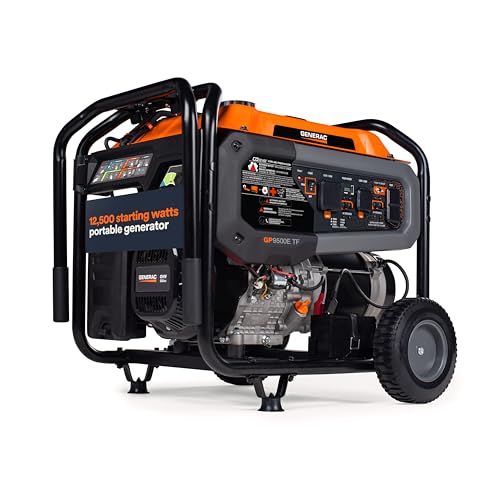
Generac 12,500W Tri-Fuel Generator with EFI
Best for: Homeowners needing tri-fuel backup power
- Running Wattage
- 8550 W (Propane), 7000 W (Natural Gas)
- Fuel Type
- Tri Fuel (Gas, Propane, Natural Gas)
- Output Ports
- 1 GFCI duplex, 1 L14-30R, 1 NEMA 14-50R
- Voltage
- 120V, 120V/240V
- Application
- Home, RV
- Start Type
- Electric Start
View on Amazon: Generac 12,500W Tri-Fuel Generator with EFI Affiliate link
The Generac 12,500 Watt Tri Fuel Generator offers electric start with recoil backup and CO Sense safety shutdown. It runs on gasoline, propane, or natural gas. You get 8,550 running watts on propane and 7,000 on natural gas. The unit weighs 227 pounds and includes never-flat wheels. It suits homeowners needing reliable backup power with multiple fuel options.
Pros
- Tri-fuel capability with propane and natural gas options
- CO Sense technology for automatic shutdown on high carbon monoxide
- Electric start with recoil backup and included 12V battery
- 14-hour runtime on gasoline at 25% load
Cons
- Heavy 227-pound build requires effort to move
- Lower running watts on natural gas compared to gasoline
- No remote start feature listed in specifications
Good fit if
- You need a tri-fuel generator for backup power
- You want electric start with recoil backup
- You require CO safety monitoring
Skip if
- You prefer a lighter unit under 200 pounds
- You only use gasoline and need maximum watts
- You want remote start capability
Verdict: Generac 12,500W Tri-Fuel Generator is a heavy-duty option for homeowners who need tri-fuel flexibility and CO safety. It fits those who prioritize electric start and automatic shutdown features over portability.
Specifications side by side
| Spec | Westinghouse 12500-Watt Dual-Fuel Generator | Generac 12,500W Tri-Fuel Generator with EFI |
|---|---|---|
| Running Wattage | 9,500 W (gas) / 8,500 W (propane) | 8550 W (Propane), 7000 W (Natural Gas) |
| Surge Wattage | 12,500 W (gas) / 11,200 W (propane) | not stated |
| Fuel Type | Dual Fuel (Gas and Propane) | Tri Fuel (Gas, Propane, Natural Gas) |
| Output Ports | not stated | 1 GFCI duplex, 1 L14-30R, 1 NEMA 14-50R |
| Voltage | 120V/240V | 120V, 120V/240V |
| Application | Home | Home, RV |
| Start Type | Electric Start, Remote Start | Electric Start |
| Features | Transfer Switch Ready | not stated |
| Dimensions | 27.2 × 26.1 × 26.5 inches | 27.2 × 26.9 × 27 inches |
| Weight | 210 pounds | 227 pounds |
| Size | WGen9500DF | not stated |
| Color | - CARB Compliant | Orange |
| Model | WGen9500DF | 8061 |
Frequently asked questions
Which generator is better for home backup, Westinghouse or Generac?
Both units are suitable for home backup, but they serve different needs. The Westinghouse 12500-Watt Dual-Fuel Generator is ideal for users who value remote start capabilities. The Generac 12,500W Tri-Fuel Generator is better for those needing natural gas connectivity. Both models are transfer switch ready or compatible, ensuring reliable power during outages.
Does the Westinghouse generator have remote start?
Yes, the Westinghouse 12500-Watt Dual-Fuel Generator includes remote start functionality. This feature allows you to operate the unit from a distance, which is convenient for safety and ease of use. It also features electric start as a backup ignition method. This combination provides flexibility in how you initiate power generation during emergencies.
What is the weight difference between these two generators?
The Generac model is heavier than the Westinghouse option. The Generac 12,500W Tri-Fuel Generator weighs 227 pounds. The Westinghouse 12500-Watt Dual-Fuel Generator weighs 210 pounds. This 17-pound difference may affect portability if you need to move the unit frequently. Both are heavy-duty units designed for stationary home backup rather than frequent transport.
Can I use natural gas with the Westinghouse generator?
No, the Westinghouse 12500-Watt Dual-Fuel Generator does not support natural gas. It is a dual-fuel model, meaning it runs on gasoline and liquid propane. If you require natural gas capability, you should consider the Generac 12,500W Tri-Fuel Generator instead. The Generac model supports gasoline, liquid propane, and natural gas via a single dial switch.
Are these generators transfer switch ready?
The Westinghouse 12500-Watt Dual-Fuel Generator is explicitly listed as transfer switch ready. This means it can connect to your home’s transfer switch for automatic or manual power switching. The Generac model is designed for home backup but is not explicitly labeled as transfer switch ready in the provided data. You should verify compatibility with your specific transfer switch setup before purchase.
Which generator is smaller in size?
The Westinghouse generator has slightly smaller dimensions. Its width is 26.1 inches, while the Generac model is 26.9 inches wide. The lengths are nearly identical at 27.2 inches. The heights are also very close, with the Westinghouse at 26.5 inches and the Generac at 27 inches. Both units have a similar physical footprint for home placement.